
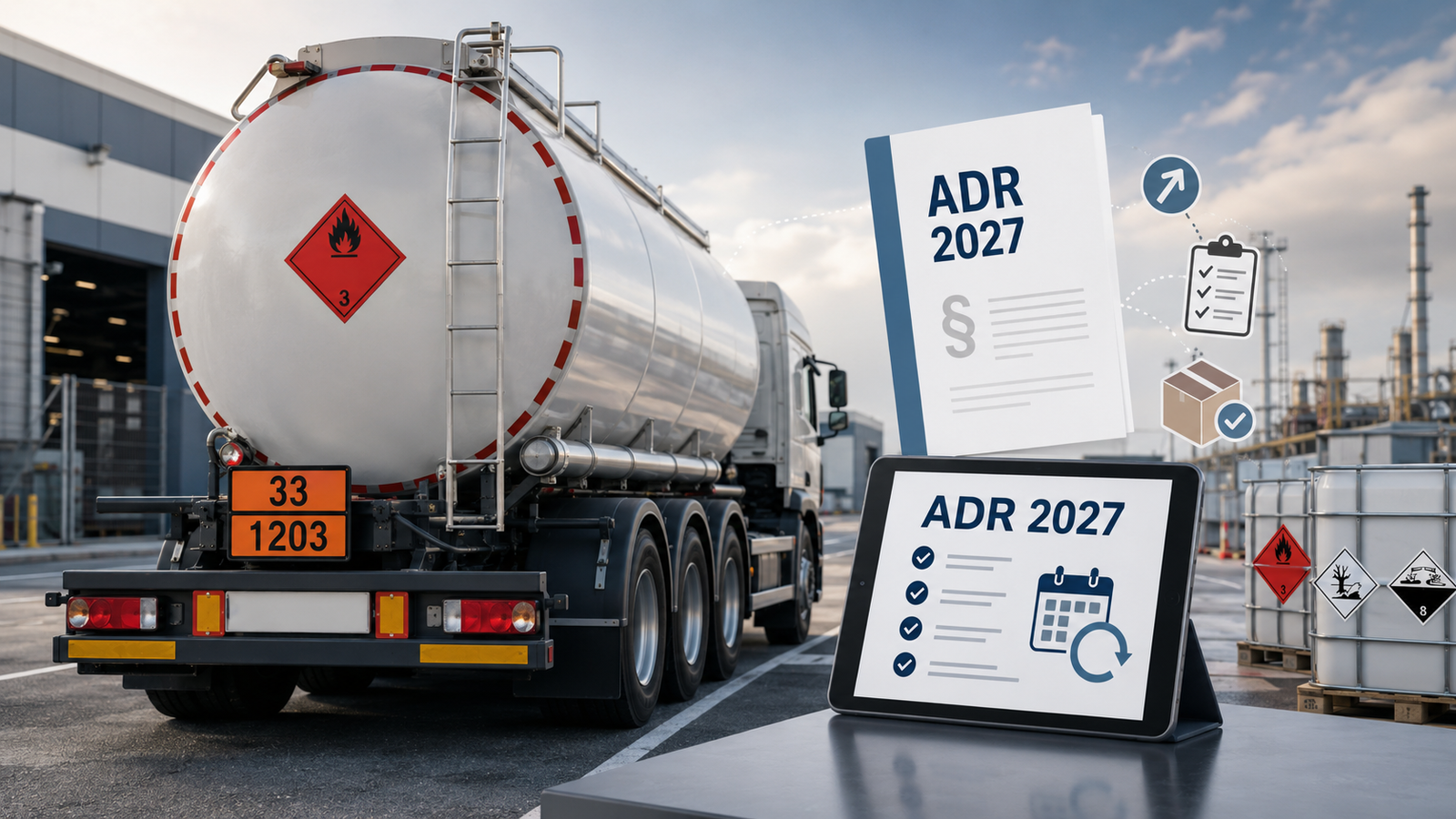
The European Agreement concerning the International Carriage of Dangerous Goods by Road (ADR) is revised every two years to reflect technological developments, lessons learned from incidents, new transport methods, and updates adopted within the United Nations Model Regulations. The 2027 edition continues this process by introducing a series of amendments aimed at improving safety, harmonising international requirements and addressing the rapid evolution of new technologies, particularly in the field of lithium batteries and electrically powered vehicles.
Although many amendments in ADR 2027 are editorial or intended to clarify existing provisions, several changes will have a direct impact on manufacturers, consignors, packers, loaders, carriers, tank operators, Dangerous Goods Safety Advisers (DGSAs), enforcement authorities and training providers. Companies involved in the transport of dangerous goods should begin reviewing these developments well before the new edition becomes mandatory in order to ensure a smooth transition.
ADR 2027 Continues International Harmonisation
One of the primary objectives of ADR is to maintain consistency with the United Nations Recommendations on the Transport of Dangerous Goods – Model Regulations. The 2027 edition incorporates amendments from the latest UN recommendations, ensuring that road transport remains aligned with international requirements applied to sea, rail and air transport.
This harmonisation simplifies international trade, reduces differences between transport modes and helps multinational organisations implement a single hazardous materials management system across their operations.
Interested in an ADR Awareness course?: Click ADR Awareness
As a result, ADR 2027 introduces a number of new UN numbers, revised Proper Shipping Names, updated classification criteria, amended Special Provisions and several changes to packaging instructions. While many of these amendments are technical in nature, they improve consistency throughout the regulations and reduce uncertainty during classification and transport.
Lithium Batteries Remain the Highest Priority
Without question, lithium batteries remain the most significant topic within ADR 2027. Over the past decade the transport of lithium batteries has increased dramatically due to the rapid growth of electric vehicles, renewable energy storage systems and portable electronic devices. At the same time, incidents involving thermal runaway, battery fires and damaged batteries have highlighted the need for increasingly detailed transport requirements.
ADR 2027 further strengthens the regulatory framework for lithium batteries by clarifying the transport conditions for damaged, defective and waste batteries. Particular attention has been given to batteries presenting an increased risk of thermal runaway, where additional safety measures are necessary during packaging, handling and transportation.
The updated provisions also recognise the expanding circular economy. Increasing numbers of batteries are transported for repair, refurbishment, recycling or disposal, creating transport scenarios that were relatively uncommon only a few years ago. ADR 2027 therefore provides additional guidance for collection systems, reverse logistics and waste battery shipments.
These amendments will particularly affect battery manufacturers, vehicle manufacturers, logistics providers, recycling companies and organisations involved in energy storage technologies.
Growing Recognition of Electric Vehicles
The increasing number of battery-electric and hybrid vehicles operating throughout Europe has also influenced ADR 2027. The regulations acknowledge that transport vehicles themselves are evolving, requiring consideration of new technologies, alternative propulsion systems and associated safety risks.
Although ADR has traditionally focused on the dangerous goods being transported, the safety characteristics of modern transport vehicles are becoming increasingly relevant. Updated technical provisions provide greater clarity regarding electrically powered transport units and their interaction with existing ADR vehicle requirements.
These developments ensure that ADR continues to support innovation while maintaining high safety standards throughout the transport chain.
Improved Provisions for Empty Uncleaned Packagings
Empty packaging often receives less attention than full dangerous goods packages, yet residual hazardous substances may still present significant risks. ADR 2027 introduces several clarifications relating to empty, uncleaned drums, intermediate bulk containers (IBCs), cylinders and other packaging types.
The revised text improves understanding of documentation requirements, transport conditions and the handling of residues that remain after the original dangerous goods have been removed. These clarifications are expected to reduce inconsistent interpretations between consignors, carriers and enforcement authorities.
For many companies involved in chemical distribution and industrial logistics, these amendments will simplify daily operations while maintaining an appropriate level of safety.
Packaging Requirements Continue to Evolve
Packaging remains one of the most important barriers against accidental releases during transport. ADR 2027 therefore includes several amendments to packaging provisions, including revised packaging instructions, updated references to international standards and clarifications regarding the use of combination packagings and UN approved packagings.
The amendments are intended to improve packaging performance, ensure greater consistency between transport modes and reflect advances in packaging technology. Manufacturers of dangerous goods packaging will need to review these developments carefully to ensure continued compliance with certification and testing requirements.
Users of UN approved packaging should also verify that existing packaging specifications remain suitable under the revised provisions.
Updates Affecting Tank Transport
Tank transport continues to receive considerable attention due to the potentially severe consequences of tank failures. ADR 2027 includes several technical amendments relating to tank provisions, inspection requirements, tank codes and references to applicable standards.
Although many of these changes are highly specialised, they are important for tank operators, inspection bodies, vehicle manufacturers and engineering companies responsible for tank design and maintenance.
As with previous ADR editions, these amendments are intended to improve consistency rather than fundamentally change the principles governing tank transport.
Documentation Requirements Become Clearer
Accurate documentation remains essential for emergency responders, enforcement authorities and everyone involved in the transport chain. ADR 2027 therefore introduces several textual improvements designed to clarify transport documentation requirements.
These include revised wording for transport documents, additional guidance concerning mandatory information and improved references to Special Provisions where supplementary statements may be required.
While most organisations will not experience major procedural changes, companies should review their transport documentation templates to ensure continued compliance once ADR 2027 enters into force.
Training and Competence
Competence remains one of the cornerstones of dangerous goods safety. Even the most comprehensive regulations cannot prevent incidents if personnel are not adequately trained.
ADR 2027 therefore includes several clarifications concerning training provisions and the recognition of ADR certificates. Although the overall structure of Chapter 1.3 training remains unchanged, the revised wording aims to improve consistency throughout Europe and eliminate differing national interpretations.
Training providers will need to update their course materials, examination questions and practical examples to reflect the latest regulatory changes. Dangerous Goods Safety Advisers should likewise ensure that internal training programmes are revised before the end of the transition period.
Vehicle Requirements Continue to Develop
Part 9 of ADR has also been updated to reflect technological developments within commercial vehicles. Amendments include refinements relating to electrical systems, alternative propulsion technologies and references to updated technical standards.
As transport vehicles become increasingly sophisticated, ADR must continue to ensure that safety requirements remain compatible with modern engineering practices without compromising operational safety.
Fleet operators purchasing new ADR vehicles should therefore verify that manufacturers have incorporated the latest regulatory requirements.
Numerous Editorial Improvements
In addition to the more visible amendments, ADR 2027 contains hundreds of editorial corrections, updated references and harmonisation changes.
Although these modifications may appear relatively minor, they play an important role in improving the readability of the regulations and reducing inconsistent interpretations between different countries. Harmonisation with RID and ADN has also been further strengthened, making multimodal transport easier for organisations operating across several transport modes.
These improvements contribute to a more coherent regulatory framework while maintaining the high level of safety expected throughout the European dangerous goods transport industry.
Preparing for ADR 2027
Although ADR 2027 officially enters into force on 1 January 2027, organisations should begin preparations well in advance. Early implementation reduces compliance risks and allows sufficient time to update procedures, documentation and training programmes.
Companies should consider reviewing their dangerous goods classifications, packaging specifications, transport documentation, operating procedures and employee training. Dangerous Goods Safety Advisers can play a central role in coordinating these activities and ensuring that the organisation remains fully compliant.
Businesses involved in lithium battery logistics, recycling operations, electric vehicles or tank transport should pay particular attention to the new provisions, as these sectors are expected to experience the greatest practical impact.
Looking Ahead
ADR has continuously evolved for more than six decades, adapting to technological innovation, changing transport patterns and lessons learned from real-world incidents. ADR 2027 represents another important milestone in that evolution.
The continued emphasis on lithium battery safety, sustainable transport solutions and international harmonisation demonstrates that the dangerous goods industry is entering a new phase in which emerging technologies and environmental considerations increasingly influence regulatory development.
For organisations that transport dangerous goods, compliance should not simply be viewed as a legal obligation. Proper implementation of ADR contributes directly to safer transport operations, improved risk management, greater operational efficiency and enhanced protection for employees, emergency responders, the public and the environment.
Companies that proactively prepare for ADR 2027 will not only ensure regulatory compliance but will also strengthen their overall safety culture and demonstrate their commitment to best practice within the global hazardous materials industry.