
When dangerous goods are transported by road, the full requirements of ADR can involve classification, UN-approved packaging, hazard labels, transport documentation, vehicle equipment, driver training and other operational requirements. For relatively small quantities, however, ADR provides several forms of relief from these requirements.
Two of the most important are Limited Quantities (LQ) and Excepted Quantities (EQ).
The terms are sometimes confused because both systems allow dangerous goods to be transported under reduced ADR requirements. They are, however, two different regulatory regimes. The permitted quantities, packaging requirements, markings and practical applications are different.
Understanding that difference is important for consignors, packers, warehouse employees, freight forwarders and carriers handling dangerous goods.
Limited Quantities: the LQ system
Limited Quantities are regulated by ADR Chapter 3.4.
Whether a substance may be transported as LQ can be determined from column 7a of Table A in ADR Chapter 3.2. The value shown in this column is the maximum quantity permitted for the inner packaging or article. If column 7a contains 0, the substance cannot be transported under the LQ provisions.
The important point is that LQ is not a general quantity limit applying equally to every dangerous good. The limit depends on the particular UN entry.
For many commonly transported products, the LQ provisions make it possible to place relatively small bottles, cans, containers or other inner packagings into a suitable outer packaging without applying all the requirements that would apply to a fully regulated dangerous goods package.
Under the normal LQ arrangement, dangerous goods are packed in inner packagings placed in suitable outer packagings. The total gross mass of the package must generally not exceed 30 kg. ADR also permits certain shrink-wrapped or stretch-wrapped trays, for which the total gross mass is limited to 20 kg.
This makes LQ particularly useful for distribution of products such as paints, adhesives, cleaning products, aerosols and various chemical products supplied in relatively small containers.
The Limited Quantity mark
One of the most visible differences between LQ and fully regulated dangerous goods is the package marking.
Packages prepared according to ADR Chapter 3.4 normally display the familiar Limited Quantity mark: a square set at an angle of 45 degrees, with black upper and lower sections and a contrasting centre.
The standard dimensions are 100 × 100 mm, although the mark may be reduced to at least 50 × 50 mm where the size of the package requires this.
An LQ package therefore does not simply become an ordinary parcel because the quantities are small. It is still a package containing dangerous goods and must be prepared in accordance with the applicable provisions of Chapter 3.4.
Excepted Quantities: designed for very small quantities
Excepted Quantities are covered by ADR Chapter 3.5 and operate on a much smaller scale.
Instead of the LQ values in column 7a, the starting point is column 7b of Table A. This column contains an EQ code from E0 to E5.
An E0 entry means that the dangerous good is not permitted to be transported as an Excepted Quantity. Codes E1 to E5 determine the maximum amount allowed in each inner packaging and in the complete outer package.
The ADR limits are:
- E1: 30 g or ml per inner packaging and 1,000 g or ml per outer packaging
- E2: 30 g or ml per inner packaging and 500 g or ml per outer packaging
- E3: 30 g or ml per inner packaging and 300 g or ml per outer packaging
- E4: 1 g or ml per inner packaging and 500 g or ml per outer packaging
- E5: 1 g or ml per inner packaging and 300 g or ml per outer packaging
For gases, these values are based on the water capacity of the receptacles.
The difference in scale is immediately apparent. Whereas LQ can accommodate relatively substantial consumer or industrial packages, EQ is intended for very small quantities. Typical applications may include laboratory chemicals, samples, diagnostic or analytical materials and other products supplied in very small containers.
EQ packaging is not simply smaller LQ packaging
A common mistake is to assume that an Excepted Quantity package is simply an LQ package containing less product. ADR does not work that way.
Chapter 3.5 establishes its own packaging system. An EQ package generally consists of an inner packaging, intermediate packaging and strong rigid outer packaging. Closures must be securely held in place, and cushioning must protect the inner packaging against breakage or puncture during normal transport.
For liquids, sufficient absorbent material must be provided to absorb the entire contents if an inner packaging breaks or leaks.
The completed package design must also satisfy the tests prescribed by ADR Chapter 3.5. These include a 1.8 metre drop test in specified orientations and a stacking test. This is an important distinction from LQ and demonstrates why the choice between the two systems should be made before the goods are packed.
LQ and EQ use different marks
The external markings are also completely different.
LQ packages use the black-and-white Limited Quantity diamond. EQ packages use the dedicated Excepted Quantities mark.
The EQ mark identifies the primary hazard class or division of the dangerous goods. Where the name of the consignor or consignee is not shown elsewhere on the package, this information must also be included in the mark as prescribed by Chapter 3.5.
Employees responsible for receiving, packing or checking dangerous goods should therefore be able to recognise the two marks immediately. Seeing an LQ or EQ mark is not merely a visual indication that the package contains “a small amount” of dangerous goods. Each mark represents a particular regulatory system with its own conditions.
There is also a limit on the number of EQ packages
Another significant difference is the restriction placed on Excepted Quantities at vehicle and container level.
Under ADR Chapter 3.5, the number of packages containing dangerous goods in Excepted Quantities in any vehicle or container must not exceed 1,000 packages.
This is particularly relevant for distribution operations involving large numbers of small packages. The fact that each individual package contains only tiny quantities does not mean that an unlimited number of EQ packages can be loaded into the same vehicle or container.
What about transport documentation?
Both systems provide substantial relief from the normal ADR dangerous goods documentation requirements, but the details should not be confused.
For road transport performed solely under ADR, LQ consignments meeting Chapter 3.4 are generally not subject to the normal ADR dangerous goods transport document requirement of 5.4.1.
For EQ, ADR Chapter 3.5 provides a specific rule where a document such as a CMR/CIM consignment note, bill of lading or air waybill accompanies the goods. At least one such document must contain the statement “Dangerous Goods in Excepted Quantities” and indicate the number of packages.
Multimodal transport requires additional attention. A shipment that starts by road and subsequently travels by sea or air may become subject to IMDG Code or ICAO/IATA requirements. It is therefore unsafe to assume that an ADR documentation exemption automatically applies throughout an international multimodal journey.
LQ and EQ do not eliminate the need for training
Perhaps the most important misunderstanding concerns training.
Companies sometimes assume that employees do not require dangerous goods training when they only handle Limited Quantities or Excepted Quantities. That conclusion is incorrect.
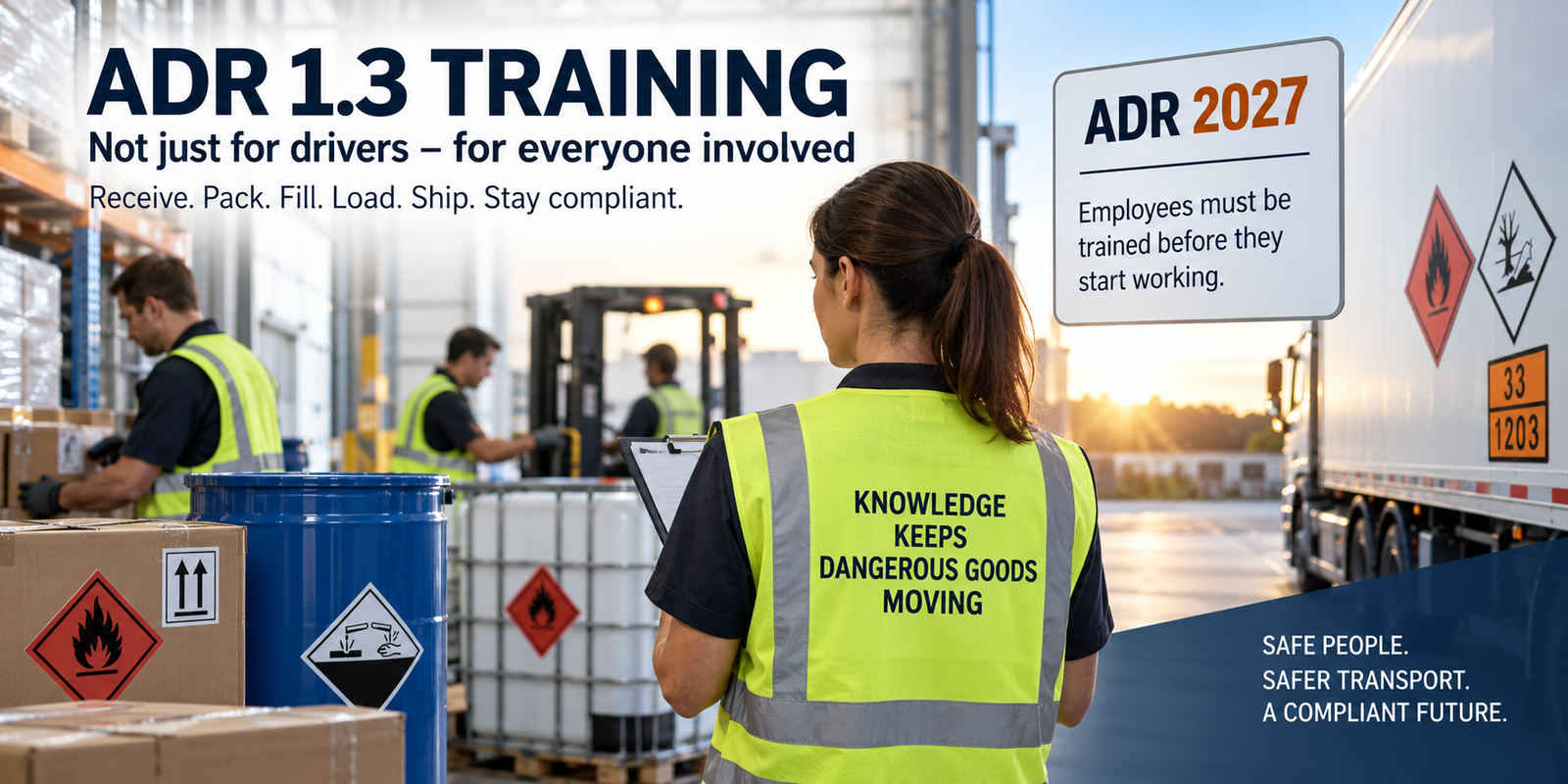
ADR Chapter 1.3 requires personnel whose duties concern the carriage of dangerous goods to receive training appropriate to their responsibilities and duties. Chapter 3.4 expressly retains relevant Chapter 1.3 requirements for LQ, while Chapter 3.5 also specifically retains the Chapter 1.3 training provisions for EQ.
This can include employees involved in preparing consignments, selecting packaging, applying markings, loading, unloading, warehouse operations, shipping administration and checking transport requirements.
The reduced transport requirements offered by LQ and EQ therefore make knowledge of ADR more important, not less important. An employee must first understand the rules before deciding whether an exemption can legally be used.
LQ or EQ: which should you use?
There is no general rule that EQ is “better” because it offers extensive exemptions, nor that LQ should always be preferred because it allows larger quantities.
The correct approach begins with the dangerous goods classification.
Identify the UN number, proper shipping name, class and packing group, where applicable. Then consult Table A in ADR Chapter 3.2. Column 7a determines the applicable LQ limit, while column 7b determines the EQ code.
Only after these values have been established should the packaging and shipping method be selected.
In practice, LQ is considerably more common in normal distribution because its quantity limits are better suited to commercial products. EQ has a more specialised role where extremely small quantities are transported.
Both systems can considerably simplify dangerous goods transport, but only when every condition attached to the exemption is satisfied.
ADR knowledge remains essential
Limited Quantities and Excepted Quantities are good examples of why ADR cannot be reduced to simply placing labels on boxes. Employees must understand classification, quantity limits, packaging, markings, exemptions and their own responsibilities within the transport chain.
A package may contain the same dangerous substance yet be subject to very different requirements depending on its quantity, packaging configuration and the exemption being used.
For employees involved in packing, shipping, loading, unloading, receiving or otherwise handling dangerous goods, ADR awareness training provides the foundation needed to recognise these differences and apply the rules correctly.
Want to improve your knowledge of ADR, including Limited Quantities, packaging, labelling and the responsibilities of the different parties in the transport chain?
Follow an ADR Awareness (1.3) e-learning course through ADR-Online. The courses are available online in multiple languages and are designed for employees whose work involves the transport and handling of dangerous goods.
View the ADR Awareness (1.3) courses on ADR-Online.eu and choose the language that suits you.
